When the school year starts and the house empties out at the same time every morning, your dog’s daily routine changes overnight. Dogs read the shape of a day closely: who leaves, when the food bowl appears, how long the quiet stretches last. When that shape shifts suddenly, even a well-settled dog can seem a little unmoored. September is a good moment to rebuild the rhythm your dog counts on, and a few deliberate choices in the first couple of weeks can make the whole season easier on both of you.
What Actually Changes for Your Dog in the Fall
The most obvious change is time alone. Summer often means a rotating cast of people in and out of the house: kids on break, flexible work hours, guests, long weekends. Fall consolidates all of that into one predictable but much longer stretch of solitude. For a dog who spent July with company on tap, a quiet six or eight hours is a real adjustment, and it is the part of a fall schedule change most dogs feel first.
The second change is the drop in activity, and it tends to sneak up on families. Daylight shrinks on both ends of the day. Evening walks get compressed into the half hour before dark. The backyard sessions that used to fill an afternoon shrink to a few minutes. Many dogs go from a summer of near-constant stimulation to a fall of long, quiet afternoons, and that mismatch often shows up as restlessness, chewing, counter-surfing, or a dog who meets you at the door with more energy than either of you knows what to do with.
Why Dogs Lean So Heavily on Routine
Dogs are excellent pattern-matchers. They learn the day as a sequence of events: the alarm means breakfast is coming, shoes by the door mean a walk, the laptop closing means someone is finally available. Those sequences are how a dog makes sense of the household, and the predictability is what allows real relaxation. When the pattern holds, there is nothing to brace for.
This is much of the thinking behind our Whole Dog Care philosophy, which looks at a dog’s physical exercise, mental engagement, and rest as parts of one connected picture. Many dogs benefit from a day with a recognizable arc to it: a busy stretch, a settled stretch, and reliable bookends. A daily routine gives you a simple framework for building that arc without having to reinvent the day every morning.
Predictability Can Contribute to Confidence
A dog who can anticipate the day tends to move through it with more ease. There is less pacing at the window, less shadowing from room to room, less of that low-grade vigilance that keeps a dog from truly resting. Anticipation is a kind of security, and it costs nothing to offer.
That steadiness often carries into new situations, too. A dog whose baseline is calm has more room to handle the unfamiliar, whether that is a visitor, a vet trip, or a change in the walking route, because the rest of life is holding steady underneath. September’s focus on confidence and connection is a good reminder that the groundwork for both is usually laid in ordinary daily habits.
How to Rebuild Your Dog’s Daily Routine
You do not need an elaborate schedule. Two anchors, one job for the middle of the day, and protected rest cover most of what a dog is looking for. Here is how each piece tends to work in practice.
Give the new pattern a couple of weeks before you judge it. Dogs settle into rhythms gradually, and the first few days of any change are rarely representative of where things land.
Anchor the Day at Both Ends
Pick a morning time and an evening time and hold them reasonably steady, even on weekends. Feeding is the easiest anchor to build around, since it is already happening and it is easy to keep consistent. Regular meal timing may help support a steadier body clock, and it gives your dog two dependable points to organize the day around.
A short, deliberate goodbye and a low-key greeting are worth adding to those anchors. Big emotional departures and arrivals tend to raise the temperature of the whole transition. Keeping both ends undramatic is designed to encourage your dog to read them as ordinary parts of the day.
Give the Middle of the Day a Job
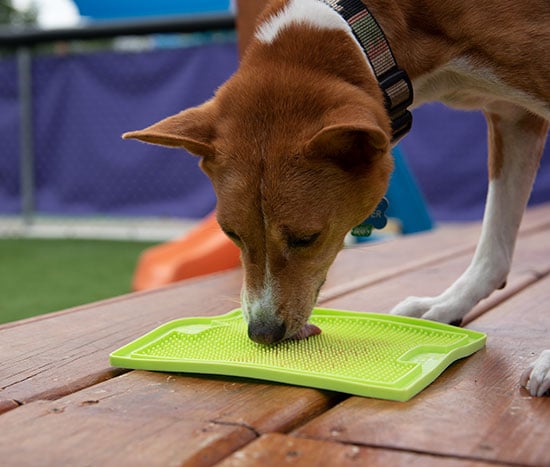
The long empty stretch is where trouble tends to gather, so it helps to fill some of it on purpose. Rotating puzzle feeders, snuffle mats, a frozen stuffed toy, or a chew saved specifically for that window can turn dead time into something a dog looks forward to. Rotation matters more than variety: three toys cycled through the week hold interest better than a bin of twelve left out all week.
For a lot of families, the honest answer is that the gap is bigger than enrichment toys can cover, and that is where a day or two a week of structured day care built around enrichment can carry real weight. A supervised day breaks up the week, offers social contact and mental work, and takes the pressure off the evening, which is often the part of the fall schedule families find hardest.
Protect the Rest
Rest is the piece most often left out of a routine, and it deserves as much attention as activity. Adult dogs sleep a great deal, and puppies and seniors more still. A dog who goes without an uninterrupted stretch of downtime can end up wound tight by the end of the day. That is why our day care programs build mandatory rest periods into the schedule.
At home, that means a bed somewhere out of the main traffic and a household norm that a sleeping dog is left alone. If your dog comes home from a busy day and sleeps hard, that is usually a good sign. The deep sleep that follows a full day is what recovery looks like.
What Settling In Looks Like
Give it two or three weeks and you can usually see the new rhythm taking hold. Your dog starts drifting toward the bed at roughly the same time each evening. The morning routine stops feeling like a negotiation. Departures get less eventful. Meals get met with steady interest.
Progress is rarely a straight line, and a bumpy Monday after a busy weekend is a normal part of settling in. Look at the general direction over a few weeks.
A Good Month for Connection
September carries Responsible Dog Ownership Month and National Dog Week from the 20th through the 26th, and both land nicely on the same idea. A lot of responsible ownership comes down to the unglamorous consistency of showing up at the same times with the same expectations.
If you want to mark the month, small rituals travel well. A dedicated ten minutes of training games after dinner. A new walking route on Saturdays. A standing day care day your dog starts to recognize and look forward to. Those habits compound quietly across the fall and outlast the month itself.
Getting Started
Getting your dog back into routine can happen gradually. Pick the two anchors first, add one enrichment habit for the middle of the day, and protect the rest. The rest of the season tends to get easier from there.
If the weekday gap is the piece that is hardest to cover on your own, we would be glad to help. Find the Central Bark nearest you to talk through what a day looks like and how a standing day or two a week could fit your family’s fall schedule.
If you have concerns about your dog’s health or behavior, please consult your veterinarian or a qualified professional. This content is intended for general informational purposes only and does not constitute medical or behavioral advice.